Why does your car look duller every year, even when you keep it clean?
Most car owners in Noida reach the same realisation at some point. You get the car washed on a Saturday, it looks great for about two days, and by Tuesday it is coated in a fine layer of dust again. You notice the paint no longer has the same depth it did when the car was new. The bonnet has faint swirl marks from years of unprofessional washing and cleaning.
The colour feels a little flatter every year.
This is not about neglect. It is just what Noida does to car paint over time, and it happens to everyone.
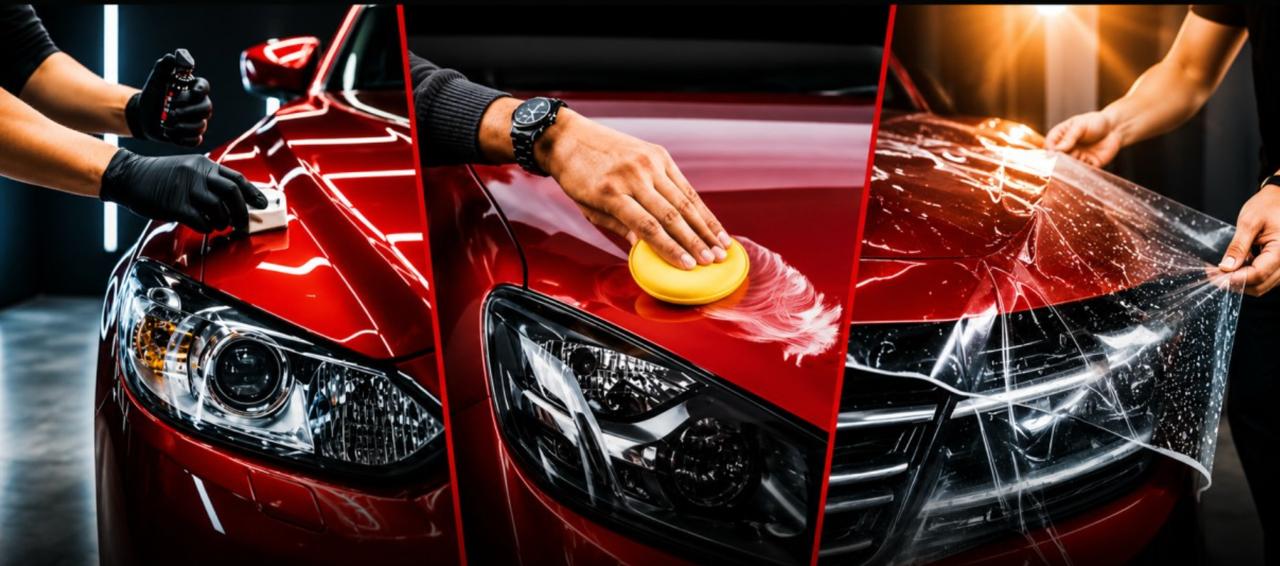
Ceramic coating does not stop the world from being dusty and harsh. What it does is create a chemically bonded protective layer over your paint that makes dirt less likely to stick, contaminants easier to clean, and the surface far more resistant to UV exposure, pollution, and hard water stains.
At Auto Meisters, located at BR-85, Sector 116, Noida, we apply professional-grade ceramic coating with a preparation and process standard that the coating actually deserves.
If you are also considering physical paint protection alongside ceramic, please read about our PPF service, which covers how the two work together.
If you want to understand the most durable coating option available, take a look at our Graphene Coating page alongside this one.
Ceramic coating is a liquid polymer primarily composed of silicon dioxide (SiO2), sometimes combined with titanium dioxide or graphene oxide depending on the formulation.
When applied correctly to a car’s paint surface, it does not just sit on top like wax does. It chemically bonds with the factory clear coat at the molecular level, forming a hard, transparent layer that becomes part of the paint system itself.
The result is a surface that behaves very differently. Instead of water spreading across the paint and drying slowly, it forms tight beads and rolls off easily, carrying light dust and contamination with it.
The water supply across Noida and much of UP has a high mineral content. Every wash that is not properly dried, every rain shower left sitting on a hot bonnet, and every water spot baked under the sun leaves behind calcium and magnesium deposits that slowly etch into the clear coat over time.
This is one of the most common types of paint damage we see, and it usually builds up gradually without people noticing until the paint is inspected under direct light.
Noida summers regularly hit 45 degrees Celsius with intense direct sunlight. Unprotected clear coat oxidises and fades significantly faster in this climate than in cooler regions.
Dark colours especially suffer, since they lose depth and develop a faint chalky cast after a few years of full sun exposure. Ceramic coating contains UV-blocking compounds that slow this process considerably.
The constant construction activity across Noida and Greater Noida makes fine dust in the air unavoidable.
This dust settles on the car’s surface and, when wiped off without proper washing technique, creates swirl marks.
Bird droppings are mildly acidic and under Noida’s intense summer heat, it can damage the clear coat within just a few hours if left unattended.
Industrial fallout from traffic and nearby manufacturing areas also deposits tiny iron particles onto the paint, which can gradually lead to staining and surface contamination over time.
Ceramic coating helps protect against all of these. It does not make your car damage-proof, but it adds a meaningful layer of protection against the kind of exposure your car faces every day in this city.
It is worth being straightforward about both sides of this.
If protection against stone chips is important for your driving conditions, especially on roads like the Noida Expressway or Yamuna Expressway, Paint Protection Film (PPF) is the solution for you. Many of our clients combine PPF with ceramic coating, and together they provide more complete protection than either option alone.
We work with professional-grade coatings from brands that have earned their reputation through consistent performance, not marketing spend. Our recommendation is based on your car, your usage, and what you actually want from the protection.
SONAX is a German automotive care company founded in 1950, and the Profiline range represents the professional-grade tier of their lineup, developed specifically for trained installers.
We use the Profiline Evo ceramic coating for our premium installations because it delivers strong gloss depth, excellent hydrophobic performance, and durable protection against the fine swirl marks and contamination common in daily Noida driving. Its SiO2 chemistry bonds cleanly to prepared paint surfaces and offers a consistent curing process, which is important for installation quality.
What also sets Sonax apart is its engineering background. Beyond automotive detailing, Sonax products are used in demanding environments including aviation maintenance and aircraft applications, including Boeing aircraft, where surface protection standards are extremely high.
Best suited for: daily-driven vehicles and owners who want long-term gloss, easier maintenance, and protection backed by a globally respected brand.
Saint-Gobain is a French company with nearly 4 centuries of history in advanced materials, from architectural glass to high-performance industrial coatings.
Their ceramic coating delivers strong UV resistance, chemical protection, hydrophobic performance, and excellent optical clarity for long term paint protection.
Best suited for new cars, owners who prefer globally established brands, and vehicles where gloss and finish quality matter.
Onyx is a professional grade ceramic coating that offers solid hydrophobic performance, UV resistance, and gloss enhancement for daily driven vehicles. It does not carry the global brand heritage of Sonax or Saint-Gobain, but it delivers solid, dependable protection at a price point that makes ceramic coating accessible for a wider range of vehicles and ownership situations.
Best suited for: mid-segment daily drivers, owners whose primary concern is practical protection rather than brand prestige, and cars where the economics of a premium coating tier are difficult to justify.
We offer two transparent ceramic coating packages based on the level of long term maintenance support included.
Includes one complimentary maintenance visit during the coverage period.
Includes three complimentary maintenance visits scheduled across the coverage period, along with complimentary premium car wash services every three months.
Every package includes:
Each maintenance visit is a proper detailing and coating maintenance session, not a quick rinse wash. The purpose is to restore hydrophobic performance, maintain gloss levels, and extend the life of the coating over time.
There are no hidden charges, no separate billing for correction work, and no surprise add ons later. The price quoted is the final price you pay.
| Feature | Wax | Ceramic Coating | PPF |
|---|---|---|---|
| How it works | Surface product | Chemically bonds | Physical film barrier |
| Protection Duration | Few months | Years | Long term |
| UV Protection | Minimal | Strong | Good |
| Chemical Resistance | Minimal | Yes | Yes |
| Stone Chip Protection | No | No | Yes |
| Scratch Protection | No | Light swirl resistance | Yes |
Wax is a surface product. It sits on the paint rather than bonding to it. A good wax application looks great and lasts a few months before washing and environmental exposure degrade it to the point of reapplication. It provides minimal UV protection, no meaningful chemical resistance, and no hardness benefit. Wax is outclassed by ceramic coating in almost every meaningful way.
Ceramic coating bonds chemically to the paint surface and lasts years rather than months. It provides UV protection, chemical resistance, hydrophobic properties, and surface hardness that wax simply cannot replicate. The trade-off is that application requires significantly more preparation and skill, which is why professional installation is the right approach.
PPF operates on an entirely different basis. While ceramic coating works chemically and measures in microns of thickness, PPF is a physical film measuring 150 to 200 microns that acts as a sacrificial barrier against stone chips, scratches, and physical impacts. These are problems ceramic coating cannot address. The combination of both is what we recommend for cars.
It’s important to understand that choosing right brand of Ceramic coating itself is perhaps 30% of the job. The other 70% is preparation & Application. A coating applied to a poorly prepared surface will perform worse, bond less effectively, and look less impressive than the product is capable of delivering. So here's exactly what we do to maximize the results:
We start with a multi-stage decontamination wash. This is not a standard car wash. It begins with a foam pre-soak to break surface contamination, followed by a Professional Car wash .
Then iron remover is applied to dissolve embedded metal particles from brake dust and road fallout. This is followed by tar remover for road deposits and adhesive residue, then clay bar treatment to produce a surface free of bonded contamination. The car is dried using filtered compressed air.
This level of decontamination is what allows the coating to bond to bare, clean paint rather than to a layer of embedded contamination.
This stage is what most studios either rush or skip entirely, and it is the one that makes the biggest visible difference to the final result.
We begin with paint depth gauge measurements across all panels to understand baseline conditions and identify any previous bodywork. Then the paint is inspected under studio lighting at multiple angles to map all swirl marks, fine scratches, oxidation, and surface defects.
Then we carefully remove swirl marks, light scratches, oxidation, and dullness from the paint to restore a clean and glossy finish before applying the ceramic coating.
The reason this matters so much: ceramic coating amplifies what is underneath it. It does not hide swirl marks or surface defects. If the paint is not properly corrected before coating, those imperfections become even more visible once the gloss increases.
That is why proper paint correction before coating is essential for a clean final result. Paint correction is included in every Auto Meisters ceramic coating package. It is not an add-on. It is part of the job.
If your car has deeper paint issues before the coating stage, our car detailing team restoration work handles restoration work as part of the overall process.
After correction, all panels are wiped down with isopropyl alcohol to remove any remaining polish oils that would interfere with chemical bonding. Non-painted surfaces, rubber seals, trim pieces, and glass edges are masked off.
Temperature and humidity in the studio are checked and confirmed within the range the coating requires for proper curing.
This stage is unglamorous but critical, because any polish residue left on the surface prevents the coating from bonding fully. Getting this step right is what separates a coating that lasts its full warranty period from one that starts to fail prematurely.
The coating is applied by hand using foam applicators, working one panel at a time to ensure even coverage and proper bonding.
Timing matters during this stage. If the coating is levelled too early or too late, it can affect the final finish and performance. Different paint surfaces react differently, which is why experience plays a major role in getting a clean result.
Premium ceramic coatings also use a base coat and top coat system. The base coat provides the primary protection, hardness, and UV resistance, while the top coat enhances gloss and hydrophobic performance.
Once the ceramic coating is applied, the car remains inside our controlled studio environment to allow the coating to cure properly.
Depending on the package and level of correction work involved, the overall process can take anywhere from 8 hours to 48 hours.
Basic coating packages for newer cars with minimal imperfections usually require less time, while vehicles undergoing full paint correction and multi layer coating applications need longer turnaround time for proper preparation and curing.
We do not rush this stage. Delivering the car immediately after coating can affect bonding and lead to issues like water spots, uneven finish, or reduced coating performance. If the coating requires overnight curing, the car stays overnight to ensure the final result performs the way it should.
Before we call you in, we do a full quality check under studio lighting.
Any high spots or application inconsistencies caught at this stage are corrected before you see the car.
When the car is ready, we walk through it together, demonstrate the water beading effect directly, explain the care instructions specific to the coating installed, and provide documentation for the warranty.
Typical turnaround: 1-year packages are generally ready within 24 hours. A 3-year premium package typically takes 2 days.
The coating continues curing during the first two weeks, and this is when it is most sensitive to damage or disturbance.
During this period:
These precautions are simple, but they are important. Disturbing the coating during the curing stage can lead to permanent issues that cannot be corrected later through maintenance.
For the best long term results, our Premium Car Wash service is specifically designed for ceramic coated vehicles and uses coating safe washing methods and products.
Ceramic coating requires controlled temperature, managed humidity, and a dust-free environment. Application in an open workshop where conditions vary with the weather cannot deliver consistent results, and in Noida's summers or monsoon months, the conditions outside are exactly wrong for curing.
Our Sector 116 studio is climate-controlled and set up specifically for this kind of work.
We do not offer ceramic coating without paint correction. The two go together, and separating them to advertise a lower headline price does not make sense to us.
If we are applying a coating that will last 1 to 3 years, the paint underneath it needs to look as good as it can. This is included, not charged separately.
If Onyx does everything you actually need, we will tell you that rather than upselling you to Sonax Profiline Evo.
If Sonax makes genuine sense for your car, your usage, and your ownership timeline, we will explain why clearly.
The goal is for you to feel the value of the investment over the coming years, not to maximise the sale on day one.
Ceramic on the paint is the headline, but a complete job means the glass, plastic trims, rubber seals, and leather surfaces are also protected. All of these are included.
A glass coating on all windows improves rain visibility and makes cleaning significantly easier.
Plastic and rubber surfaces that are left uncoated will degrade and fade noticeably faster than the protected painted panels around them.
Location. Our studio at BR-85, Sector 116, Noida is accessible from Sector 115, Sector 117, Greater Noida West, and via the Noida Expressway. Clients regularly come to us from Indirapuram, Vaishali, Crossing Republik, and across Greater Noida.
With proper maintenance, realistic lifespans are as follows. Onyx, used for our entry-level installations, typically delivers solid performance for 1 to 3 years depending on care and usage. Saint-Gobain sits in the 2 to 4 year range with good maintenance. Sonax Profiline Evo can last for 3 to 5 years under Noida conditions and has the product engineering to back that up.
The single biggest variable after installation quality is whether the owner follows the maintenance schedule. Coatings that receive regular professional upkeep consistently outlast their warranty periods. Coatings that are ignored typically start deteriorating within 2 to 3 years regardless of the original brand.
The coating application itself is done to the same preparation and quality standard in both. The difference is the maintenance support and the long-term value it creates. The 1-year package at Rs. 12,999 includes one complimentary maintenance visit. The 3-year package at Rs. 29,000 includes three.
Each visit involves a full interior and exterior detail, minor paint correction to address any new surface marks, and a hydrophobic top coat refresh across paint, wheels, glass, plastics, rubber, and leather. Both packages include ceramic coating on all surfaces, not just painted panels.
For most daily-driven cars in Noida, the 3-year package offers significantly better value over the ownership period because the maintenance visits are what keep the coating genuinely performing, not simply existing.
Yes, though less frequently and more easily. Ceramic coating makes dirt harder to adhere and easier to rinse off, so a thorough Car Wash every 2 to 3 weeks is typically sufficient for most Noida driving conditions rather than the weekly washing that bare paint often demands.
Between full washes, a light rinse handles loose dust without any scrubbing needed. The coating does not eliminate the need for maintenance. It just makes maintenance genuinely easier.
No. Ceramic coating is a chemical layer measured in microns. It improves resistance to fine surface scratching from washing and light contact, but it has no meaningful effect on stone chips or deeper scratches from significant physical contact.
For protection against stone chips, particularly for expressway driving, PPF is the right product. The combination approach, PPF on impact-prone panels and ceramic coating across the full car, gives you both chemical protection and physical impact resistance. We offer both services and regularly install them together.
Standard ceramic coating uses silicon dioxide as its primary active compound. Graphene coating blends SiO2 with graphene oxide, and the graphene component changes several performance characteristics in meaningful ways.
Graphene conducts and disperses heat efficiently, which reduces the water spotting that can occur when droplets sit on a hot surface in direct sunlight, a genuinely useful property in Noida summers.
Graphene's molecular structure also makes the coating simultaneously harder and more flexible than traditional ceramic, which improves resistance to micro-cracking under thermal cycling. The overall service life is longer.
The cost is higher, which is why we recommend it specifically for new vehicles, high-value cars, and owners planning a long ownership period. Our Graphene Coating page covers this in full detail.
Sonax has been developing professional automotive surface care products since 1950, and the Profiline range is their professional-grade line, not a consumer product.
The Evo ceramic coating specifically has been formulated for trained installers and delivers consistent bonding, strong hydrophobic performance, and gloss depth that holds up over time.
Sonax products are also used in professional environments beyond automotive detailing, including aviation maintenance contexts where surface protection standards are significantly more demanding than standard car care. That engineering culture carries through into the Profiline Evo product.
Yes, and this is exactly the situation paint correction before coating is designed for.
We assess the paint condition at intake, determine the level of correction needed, and bring the surface to the best possible condition before any coating goes on.
The correction work is included in the package price. Cars with more extensive paint history simply require more correction time, which we discuss transparently at the consultation stage. Our car detailing team handles cases where restoration needs go beyond standard pre-coating correction.

If you are considering ceramic coating for your car, the right next step is a proper conversation. Come in to our studio and we will assess your paint condition, walk you through the brand options and package durations that make sense for your car and your situation, and give you a clear quote with no hidden additions.
No pressure, no single-answer recommendation regardless of your car. Just an honest assessment and a transparent discussion about what will actually work for you.
Auto Meisters BR-85, Sector 116, Noida, Uttar Pradesh 201316